
Har ki Pauri
Millions of pilgrims and tourists hold a particular place in their hearts for Haridwar, one of India’s most revered and historic cities. Har Ki Pauri, a revered ghat on the banks of the holy River Ganges, is the center of this spiritual haven. We shall explore the background, significance, and magical encounters that await travelers at this venerable location in this essay.
Historical Importance
The history of Har Ki Pauri, also known as “the steps of Lord Shiva,” dates back to the reign of King Vikramaditya of Ujjain. This ghat is said to have been constructed by King Vikramaditya in memory of his brother Bhartrihari, who is said to have meditated here. Its holiness is increased by the legend that Lord Vishnu left his imprint on a nearby stone wall.
Ganga Aarti
The Ganga Aarti is among the most recognizable and alluring traditions of Har Ki Pauri. Priests congregate on the ghat every evening as the sun sets and the sky transforms into a tapestry of vivid hues to show their devotion to the sacred river. Hymns are chanted in a rhythmic manner, multiple oil lamps are lit, and incense sticks are waved during the event. All who observe the flickering candles, the lovely bhajans, and the peaceful atmosphere are moved to a deep level of spiritual resonance.
Typically, the season affects when the Ganga Aarti is performed at Har Ki Pauri in Haridwar. .
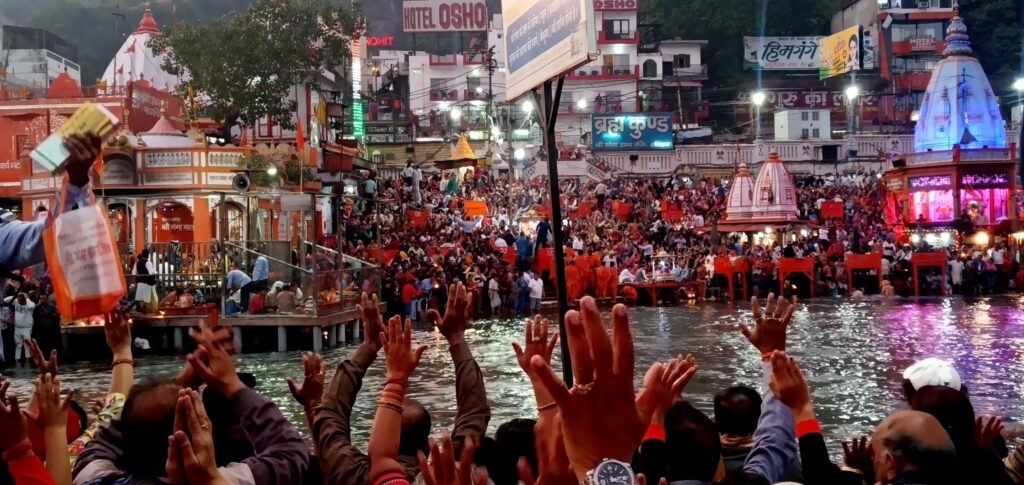
As a general rule, the Ganga Aarti timing should be as follows:
From March to June, the summer:
Evening Aarti: As the sun starts to set, the evening Ganga Aarti typically begins between 6:30 and 7:00 PM.
(July to September) Monsoon
Evening Aarti: The schedule may be a little earlier during the monsoon season, frequently beginning around 6:00 PM.
October through February is winter.
Evening Aarti: Because of the early sunset in the winter, the Ganga Aarti may commence later, at 5:30 or 6:00 PM on average
The timing may vary somewhat from year to year or due to special occasions and festivals, hence it is advised to check with local officials or the local priests at Har Ki Pauri for the exact and most recent schedule. It’s advised to arrive a little early to find a decent viewing location for the aarti, especially if you want a closer look.
Holy bathing:
Har Ki Pauri is well known for its cleaning waters. In the belief that the Ganges cleanses the soul and wipes away sins, pilgrims and tourists from all over the world travel to this location to take a holy bath. People wearing white and saffron clothing are thronging the ghats in search of spiritual enlightenment and blessings. It is both humbling and inspiring to immerse oneself in the chilly, holy waters while chanting and ceremonies are taking place in the background.
Glimpses of Local Culture:
A glimpse of the local culture can be found in the area around Har Ki Pauri, which is both a spiritual center and a bustling market. You can browse the shops here for souvenirs, colorful textiles, and religious objects. Street food vendors tempt your taste buds with mouthwatering regional treats like sweets and nibbles.
Photography and Natural Beauty:
Har Ki Pauri also provides beautiful views of the Ganges and the neighborhood. An good viewpoint for taking pictures is provided by the double-decker bridge that spans the river. You’ll have countless opportunity to take beautiful pictures, whether you choose to photograph the mesmerizing Ganga Aarti or the peaceful flow of the river against the backdrop of the city.
How to reach Har Ki Pauri
Haridwar is easily accessible by road, rail, and air, making it simple to get to Har Ki Pauri. Here are the most popular routes to take to go to Har Ki Pauri:
- In a train:
Haridwar Junction, station code HW, is the name of the railway station in Haridwar. It has excellent connections to Delhi, Mumbai, Kolkata, and Chennai, among other important cities in India. Daily trains from and to Haridwar run in large numbers.
Once you arrive at Haridwar Junction, you can take a taxi or an auto-rickshaw the two to three kilometers to Har Ki Pauri. Depending on traffic, it takes between 15 and 20 minutes to travel.
2. By Road:
Haridwar has excellent road connections to many towns in North India. You can either take a bus or drive your own car to Haridwar.
Regular bus routes to Haridwar are run by both public and private bus companies from places such Delhi, Dehradun, Rishikesh, and others.
Driving, you can choose National Highway 7 (NH7) or other suitable routes dependent on where you are starting from.
3. By Air:
The Jolly Grant Airport (Dehradun Airport), which is situated in Dehradun and is around 35–40 kilometers distant from Haridwar, is the closest airport.
To get to Haridwar from the airport, you can either take a shared taxi or hire a taxi. Depending on traffic, the trip usually takes between one and fifteen minutes.
4. By Bus:
Direct bus connections to Haridwar are available from several places, such Delhi. For information on choices, check with your neighborhood bus terminal or online bus reservation services.
It is possible to get to and from Haridwar using interstate and intrastate buses, which run both ways.
5. Using a taxi or an autorickshaw
To get to Har Ki Pauri quickly if you’re staying in the neighborhood, rent a taxi or an auto-rickshaw.
At the bus stop and the railway station in Haridwar, taxis and autorickshaws are easily accessible.
Once in Haridwar, getting to Har Ki Pauri isn’t too difficult because it’s a well-known city icon. You can use a GPS navigation program, ask locals for directions, or just follow the signs to Har Ki Pauri.
Conclusion:
Har Ki Pauri in Haridwar is more than just a ghat; it’s a spiritual haven and a meeting point for history and spirituality. It is a location that welcomes pilgrims, tourists, and anyone looking for peace to encounter the profound relationship with the divine. Everyone who has the opportunity to visit Har Ki Pauri will find it to be an amazing and spiritually enlightening experience because of the Ganga Aarti, the holy dip, the vibrant culture, and the breathtaking scenery.